
Apparently There’s a Name for All This Darkness
Tenebrism, Caravaggio, and discovering that artists have been doing dramatic things with light for centuries.
Apparently, there’s a name for all this darkness.
I discovered the word tenebrism after I’d already been painting on black for quite some time. Trust the art world to have a fancy word for something I was happily doing anyway.
It’s a rather grand-sounding word, isn’t it? Tenebrism. It sounds as though you should pronounce it while standing in a museum with your hands clasped behind your back.
But the idea behind it is wonderfully direct: use darkness and strong light to make something impossible to ignore.
That certainly caught my attention. It’s close to what I love about painting, even if my own work takes a few liberties with the traditional approach.
First, what on earth is tenebrism?
Tenebrism is a style of painting in which deep shadow dominates much of the picture and sharply lit areas pull your attention towards the subject. The name comes from a word for darkness.
You’ve probably heard of chiaroscuro too, another lovely art-world word. That refers more broadly to using light and dark to give forms depth and volume. Tenebrism takes the drama further. The shadows can become so deep that whole sections of a scene seem to vanish.
Think of a person stepping out of a dark room into a narrow beam of light. You don’t see everything. You see a face, a hand, perhaps a piece of clothing. The rest is left to your imagination.
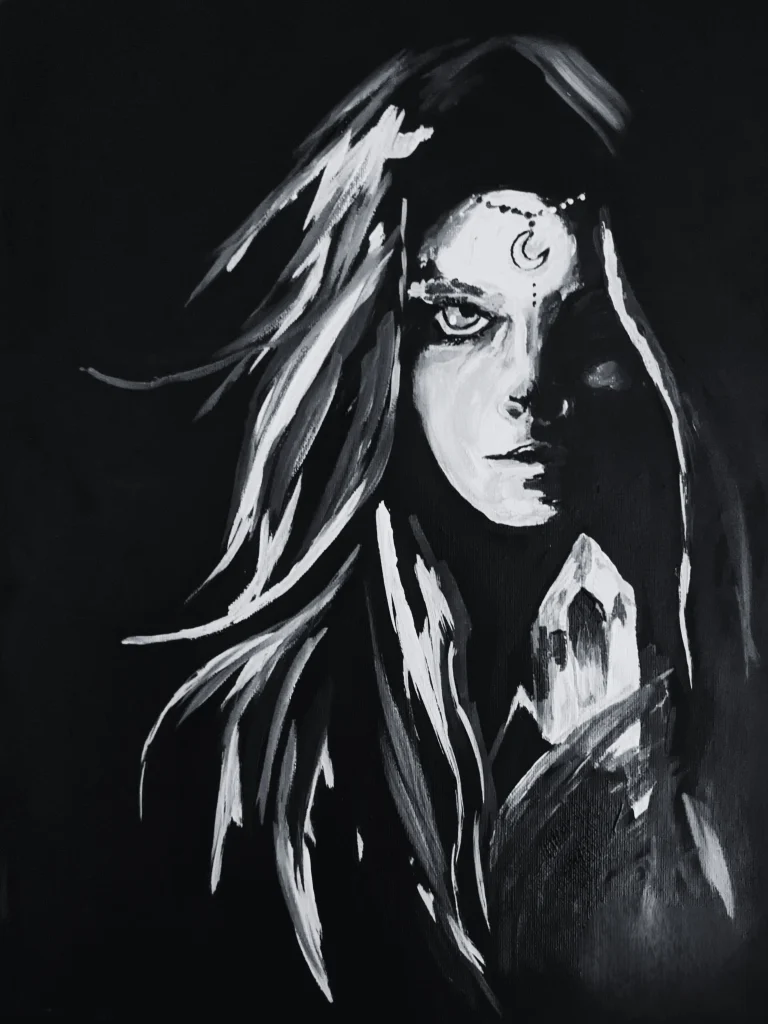
The light isn’t simply there to make the subject visible. It tells you where to look and, sometimes, what matters in the story.
That’s the part I find fascinating. You can change the entire feeling of an image by deciding what the viewer is allowed to see.
Caravaggio wasn’t exactly subtle
One of the painters most closely associated with tenebrism is Caravaggio, who worked around the turn of the seventeenth century.
If you’re expecting polite little scenes with everybody evenly lit and behaving themselves, he’s probably not your man.
His paintings often feel as though something important is happening right now. People lean into the light. Hands gesture. Faces emerge from dark backgrounds. The contrast makes ordinary human movement feel almost theatrical.
In The Calling of Saint Matthew, light enters a dim scene and helps direct your eye through a group of figures. In other works, the darkness makes the action feel startlingly close.
It’s not just the technical skill that interests me. It’s the confidence to leave so much unseen.
He didn’t need to light every corner to make the picture powerful. Quite the opposite.
Of course, Caravaggio was painting in a very different world, often telling religious stories with carefully observed human figures. I’m not pretending my paintings are doing the same job. But I recognise that delicious visual trick of letting the light carry the story.
And he wasn’t the only one
Other artists explored dramatic darkness in their own ways.
Artemisia Gentileschi, for example, used powerful contrasts of light and shadow in scenes full of tension and human emotion. Her paintings have an intensity that doesn’t depend on showing you every detail of the room.
Georges de La Tour often took a quieter approach. In some of his paintings, a candle lights a face or a pair of hands while everything beyond them slips away. The result can feel intimate rather than explosive.
I like that contrast between the artists themselves. The same broad idea, darkness against light, can produce completely different moods.
One painter can make you feel as though you’ve walked into a dramatic confrontation. Another can make you feel as though you’ve interrupted a private moment.
That says something important about the technique: darkness doesn’t come with a single emotion attached. What you do with it matters.
So am I painting tenebrism?
Well, sort of. But not in the strict historical sense.
I start my paintings on a dark surface, currently mainly black, and I love bringing a subject out of that darkness. I use white and grey to decide which parts will catch the light and which parts can disappear.
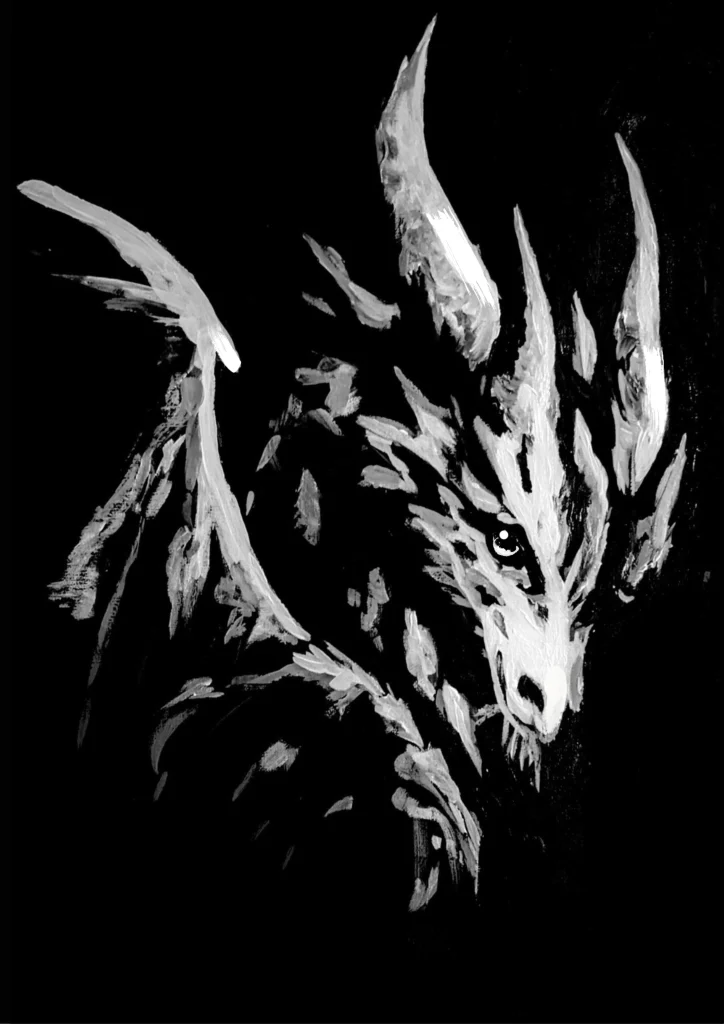
That’s certainly a family resemblance.
But I’m not trying to recreate a seventeenth-century painting. I work in acrylic, I experiment with abstraction, and I’m quite happy to let a rough, awkward brushstroke do the work of a beautifully modelled hand if it gives the subject more character.
Some of my paintings are relatively detailed, with one area emerging sharply into view. Others are made from chunky shapes or just a few expressive marks. The darkness is a constant, but the way I use it changes.
And I don’t always follow a perfectly realistic light source. I pay attention to where the light is coming from, but if a technically incorrect mark makes the painting feel stronger, I’m not going to lose sleep over it.
I like the history. I don’t particularly want to be trapped inside it.
The darkness isn’t just a backdrop
There’s another difference between looking at a photograph of a dark painting and standing in front of the original.
My surfaces begin with black gesso, which has a flat, matte finish. As I paint, I add black acrylic in places rather than covering the whole surface. The two blacks catch the light differently.
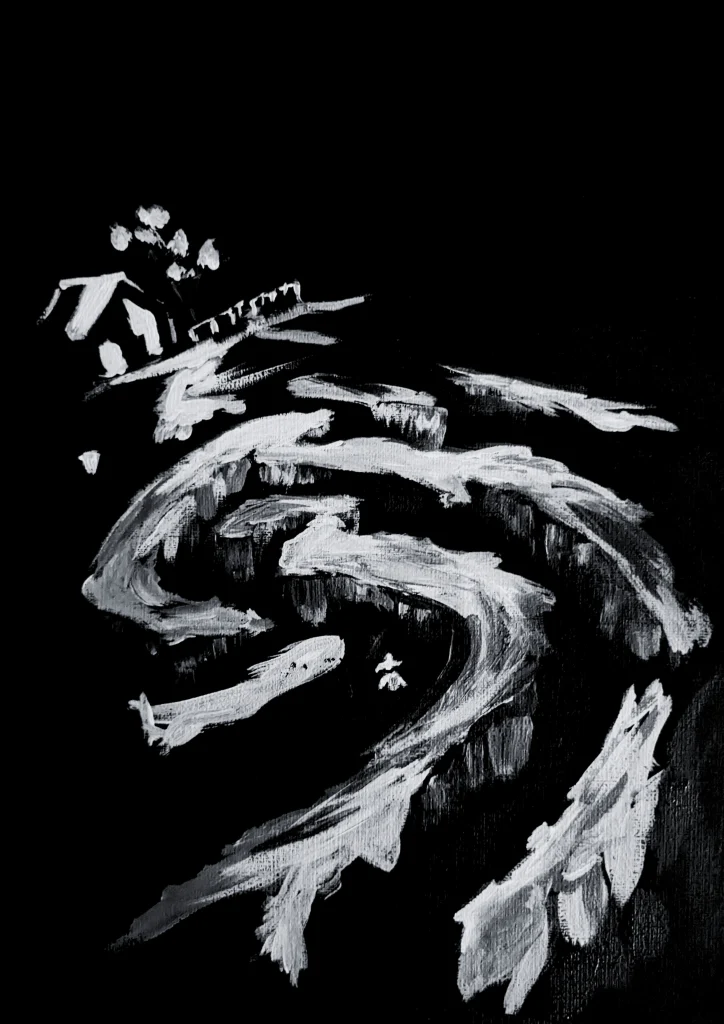
So even before you get to the white and grey, there can be a quiet conversation happening between matte and slightly shiny black.
A photograph doesn’t always show that very well. It may flatten those subtle changes into one dark area. In person, the surface can shift as you move or as the light in the room changes.
I love that. The black isn’t simply an empty space waiting for the subject. It’s already participating.
And when I begin adding the lighter marks, the surface has something to work against.
Why it still works hundreds of years later
We live surrounded by images. Bright screens, photographs, advertisements, endless things asking us to look at them.
A painting that withholds information can do something rather different.
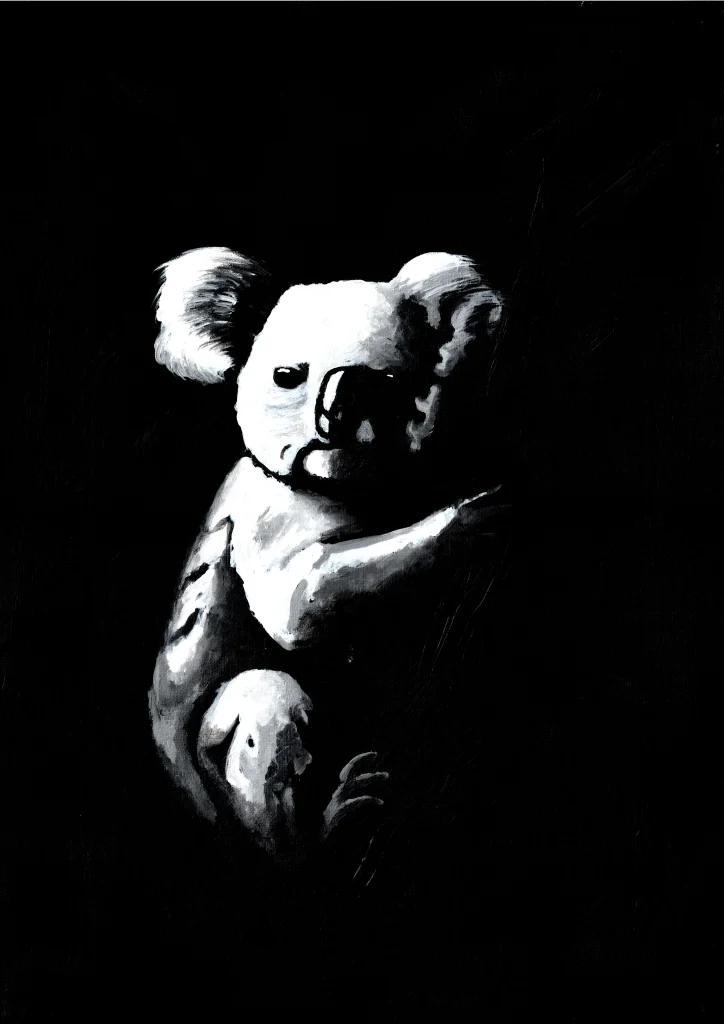
Instead of showing you everything at once, it asks you to look a little longer. You might notice an eye first, then the shape of a face, then a movement you hadn’t seen. Or you might decide the shadow is hiding something entirely different from what I had in mind.
That’s part of the pleasure for me. I don’t want to hand over a complete set of instructions for how to see a painting.
I want it to have enough presence to catch your attention, and enough mystery to reward another look.
It also explains why I can paint wildly different subjects and still feel that they belong together. A strange character, an animal, a flower or a figure in motion can all emerge from the same darkness, but each one brings its own personality.
The light might make one feel fierce and another feel fragile. Sometimes the subject looks as though it’s arriving. Sometimes it seems to be slipping away.
And sometimes, if I’m lucky, it looks as though it knows something I don’t.
A useful name, not a set of rules
I’m glad I discovered the word tenebrism. I enjoy knowing that painters centuries ago were fascinated by some of the same visual possibilities that keep me interested today.
It’s a lovely reminder that an old idea can still feel fresh when somebody approaches it in their own way.
But learning the name didn’t change how I wanted to paint. I was already enjoying the black surfaces, the selective light, the rough marks and the subjects that don’t quite reveal themselves.
I still start with an idea and let the painting develop. Some need bold white from the beginning. Others build slowly through greys. Some turn out nothing like I expected.
The historical term gives me a way to talk about one part of what I’m doing. It doesn’t explain the whole thing, and I wouldn’t want it to.
Besides, ‘I paint things emerging from the dark’ is a lot easier to say while holding a paintbrush.
Although tenebrism does sound rather impressive.
Related articles